Sèvres Vase Garniture
Artist/Maker: Sèvres Manufactory
Object Date: 1782
Materials: Porcelain body, ormolu mounts, gilding

Description
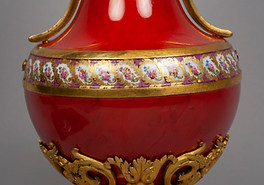
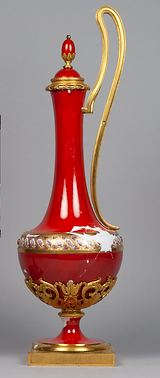
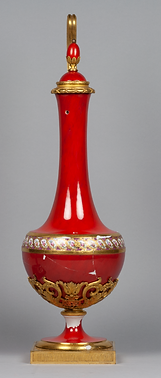
The objects are a pair of matching red ground porcelain vases with gilt bronze mounts and associated lids from a garniture of three vases. These vases flank the central vase of the garniture (not pictured). Each vase consists of a hard paste porcelain vessel and associated embellished mounts of gilt bronze. The bottom of the porcelain vessel is somewhat drum shaped with a skinny neck that tapers inward at the shoulders and a foot that tapers outward. The majority of the vase is of plain red ground; however, a narrow band of white ground sandwiched between two plain gilded bands is present below the shoulders. The central part of the band contains white reserves filled with a painted floral motif, bordered with garlands of gilt leaves and surrounded by pink vertical stripes.
Context
This garniture was created by the Sèvres porcelain manufactory which was established in 1740 in Vincennes and then moved to a new factory in Sèvres, France in 1756. Often considered the leading porcelain factory in Europe, Sèvres enjoyed great success and privilege under the patronage of Louis XV and his mistress Madame de Pompadour. This garniture was purchased for 6,000 livres by King Louis XVI in December 1782 at the annual Sèvres manufactory exhibition at Versailles.
The interlocking ‘L’ mark on the underside of each vase indicates the Sèvres manufactory, the crown indicates hard paste porcelain, the ‘EE’ inside indicates the year of production (1782), and the flower mark indicates the painter and gilder Nicholas Schradre. The gilt bronze mounts are attributed to Jean Claude Thomas Chambellan Duplessis fils (1730-83), a bronze founder and designer of gilt mounts for Sèvres. His father, Jean Claude Chambellan Duplessis, was the artistic director at Sèvres from 1740-1774. The shape and design of the garniture are attributed to architect Charles de Wailly. The garniture was acquired in 1891, though it is unclear if it was purchased by William T. or Henry Walters.

Condition
48.755
This vase is in overall good condition and structurally sound. The porcelain is in good condition and structurally sound with no cracks. Several chip losses are present on the lower body of the vase and in the decorative band across the midsection. Minor abrasion to the gilded bands is evident; however, the majority of the gilding is intact. Surface grime is visible across the object and dark splatters of an unknown material are present on the foot of the vase. Dust has accumulated on horizontal surfaces. The mounts are in fair condition overall. Black material, likely tarnish/corrosion product, is present across the mounts but more highly concentrated in recessed areas and interstices.
48.756
This vase is in overall poor condition. Though the porcelain elements and mounts are structurally sound, the connection between the main body of the porcelain vase and the foot is not solid, allowing for movement that is not intentional or desirable. This appears to be the result of damage to the gilt bronze mount at the base of the porcelain body which has been crushed on one side, allowing the vase to move more freely than if it were restrained as intended. The porcelain is in poor condition overall with surface grime, significant abrasions, accretions and poorly executed prior restorations. The gilt bronze mounts are in poor condition overall with one detached portion and several missing elements. There is one detached portion of the garland and several missing elements. White grey material and associated residues, possibly polishing compound from prior treatment, are present in interstices. Black material, likely tarnish/corrosion product, is present across the mounts but more highly concentrated in recessed areas and interstices. Abrasion and scratches to the mounts are visible across the surface.
Purpose of Treatment
This treatment was performed to improve the appearance and condition of these objects so that they could be reunited and displayed with the third member of the garniture.
Documentation and X-Radiography
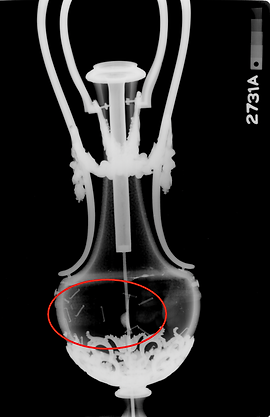
My first step was taking x-rays to gain an understanding of how the mounts are attached to the porcelain. Radiographs showed that the mounts are attached at the neck of the vase with threaded rods and nuts and at the shoulder simply through a notch in the porcelain. The entire vase is connected to the base with a threaded rod that connects halfway through the vase to the ormolu sleeve inside the neck. The radiograph of the more heavily restored vase (756) revealed many staples on the interior of the vessel which was totally unexpected but a really interesting find (center and right)!


Disassembly
Using the x-radiograph as a guide, I disassembled vase 756 into its constituent parts (the porcelain body, foot/base and various mounts). I first removed the garlands from the handles, then removed the sleeve with rod attached from inside the neck, separated the upper body and lower foot of porcelain, removed basket-like mount from main porcelain body, unscrewed bolts for exterior mounts from inside neck, and then removed the handle mounts. Watch me disassemble vase 756 in the video below.


Cleaning
I then turned to cleaning of the porcelain and ormolu mounts. I removed loose dust from recessed areas and horizontal surfaces with a soft bristled brush. I removed tape residues and accretions on porcelain, and old overpaint on mounts by swabbing with acetone (left image). I then cleaned the porcelain using pH 6.5 EDTA with a bis-tris buffer. This same solution was applied using cellulose powder as a poultice to reduce staining in joins of porcelain. I then turned to the mounts which I initially swabbing with ethanol to remove dirt and grime. I then conducted extensive tests to determine an appropriate material to reduce or remove black corrosion. I ended up using a pH 8.5 EDTA solution with bicine buffer, EcoSurf EH-6 surfactant, NaOH, 10% benzyl alcohol, gelled with xanthan. The gel was applied with a brush and allowed to briefly dwell on the surface before being agitated with a brush and removed using a cotton swab. The surface was then cleared by swabbing with distilled water followed by acetone.


Removal of Prior Restorations
Next, I turned to the various prior restorations that needed to be removed. Most overpaint was soluble in acetone; however, the red paint needed significant dwell time for any removal. After removing the overpaint, I removed the old fills using a combination of acetone and water left to dwell and soften the material, and mechanical action with a scalpel. As the fills materials were removed, 3 porcelain fragments that had previously been adhered and held in place with fill material were removed from the object. The break edges were cleaned and then the fragments adhered in place with Paraloid B-72.


Loss Compensation and Inpainting of Porcelain
I compensated losses using Hxtal NYL-1 bulked with fumed silica and tinted with dry pigments (titanium white, raw umber and ultramarine blue) to achieve the desired translucency and color. Fills were shaped and smoothed using glass papers. Fills to the floral band and red ground were then inpainted with Golden Fluid Acrylics (naphthol red, hansa yellow, raw umber) and given several coats of Primal WS-24 to achieve the desired gloss. Fills to the gold band or areas with gilt design were gilded with 22 karat gold leaf over Charbonnel LeFranc 3-hour Mixtion Gold Size.


Loss Compensation of Mounts
Missing elements of the mounts were reconstructed using Hxtal NYL-1 epoxy casts made from extant elements. For the largest element, a two-part mold was constructed of Zhermack Elite Double 8 silicone using dams made from plasticine clay. For the smaller elements, one-part molds were constructed of 3M Express STD VPS Impression Material Putty.
Cast replacement pieces were smoothed and shaped using a heated scalpel, abrasive papers and rasps. The casts and a detached portion of original ormolu garland were adhered to the ormolu mounts with Loctite epoxy for a strong join. Hxtal NYL-1 bulked with fumed silica was used to smooth the transition between the Hxtal cast and original ormolu, and add further dimensional details as necessary. The casts were painted with Golden Fluid Acrylics (red oxide) and then gilded using LeFranc and Bourgeois Charbonnel Oil Mixtion size and 22 karat gold leaf.


Reassembly
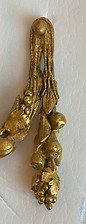
The handle mounts that had been removed from 756 for treatment were reattached with the existing screws/nuts. The garland mounts were reattached to the handle mounts using new attachment hardware made from screws with gilded epoxy balls at the ends (to match the extant hardware). The porcelain vases were attached to the base by reinserting the sleeve with rod into the neck and through the length of the vase into the base, and then secured with a nut.
The vases were given a final dusting and then photographed and returned to storage.

Image: Sarah Freshnock

Image: Sarah Freshnock
Treatment Photography - pair overall
Before Treatment

After Treatment

Treatment Photography - All sides
Before Treatment


During Treatment


After Treatment


Treatment Photography - Details
Before Treatment


During Treatment


During Treatment


After Treatment