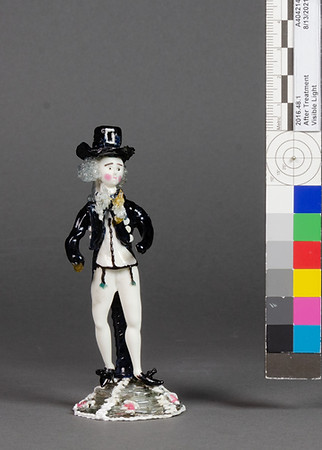
Nevers Glass Figurine
Artist/Maker: Nevers, France
Object Date: 18th-19th century
Materials: Lampworked glass, metal (est. copper and iron)
~~~
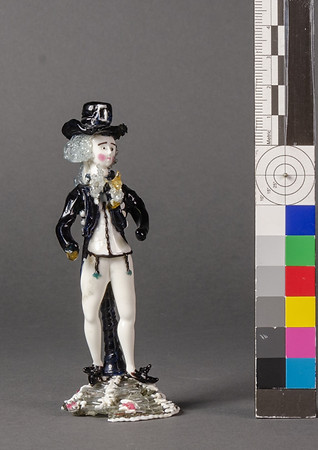
Description: The object is a colored glass standing male figurine with a wire armature. The man has light blue curly hair and wears a white shirt and pants, as well as a dark blue jacket, hat and shoes. Small details and facial features are executed in black, brown, pink and blue glass. The figure stands upon a clear glass base with white and pink decorative flourishes. Blobs of yellow restoration material are present across the figure. The object is from a group of 4 similar figures.
Condition: Overall, the object is stable but in fair to poor condition. Cracking is present throughout the figurine. The base is in poor condition. There are areas of broken and missing glass as well as areas where the wire armature has been broken/severed. Significant areas of loss include two large portions of the rim – one of which has been previously and unsuccessfully restored (the adhesive is sloppily applied and has yellowed) and one unrepaired.

Historical Context
Between the late 16th and early 19th centuries the city of Nevers, in the Loire Valley of France, produced small glass figurines which are referred to as Nevers figures or Verre de Nevers. Nevers became a center of glassmaking when Henrietta of Cleves, the Duchess of Nevers, married an Italian nobleman, Louis di Gonzaga di Mantua, Duke of Nevers in 1565. The Duke’s interest in the arts, especially glassmaking led him to establish a glasshouse and bring Italian glassworkers to France. While many different kinds of glass pieces were made in Nevers, the city is best known for its lampworked figures.
The figures are made of glass rods and tubes over a wire armature, and are typically only a few inches high but can vary quite a bit in size and proportion. The pieces depict simple folk people to religious, royal and allegorical figures and can be found as single figures, or in groupings. Often the figural groups are placed in set compositions in dioramas to convey a mythological, religious or historical scene. These dioramas can be quite complex and elaborate with many figures and decorations to set the scene.
Construction/Fabrication
Nevers figures are created by a process called lampworking. Lampworking is a type of glasswork in which a torch or lamp is used to melt the glass which, once molten, is formed by blowing and shaping with tools. This process was and still is used to create beads, marbles, ornaments small vessels and figurines.
This figurine was likely created in several stages, starting with the torso and then adding the head, limbs, base and finally details.
An interesting aspect of the construction of these lampworked figures is how the glass was formed around a wire armature and much of the glass is filled with thin wires. There are several theories about why these wires were used in the fabrication of Nevers figures. Some believe the wires were used to help keep the glass together when it inevitably cracked, likely from thermal shock, as even if the glass cracked, the wires would keep the pieces held in place. Another theory suggests that the wires helped conduct heat throughout the piece while it was being made, keeping the entire object at roughly the same temperature in an effort to avoid cracking.
Treatment
-
Carried out before treatment photodocumentation and examination report
-
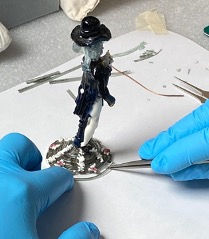
Removed dust from horizontal surfaces with a soft brush and cotton swab
-
Conducted solubility testing of yellowed epoxy restoration material to determine a suitable method for removal
-
Removed aged and yellowed epoxy fills and remnants on surface
-
Cleaned the surface of the base and removed clear material with intractable dirt by swabbing with 1:1 deionized water:ethanol
-
When the aged epoxy was removed from the base, several previously joined sections of glass became detached from one another. These areas were re-joined using 20% Paraloid B-72 in acetone, applied by brush.
-
Compensated losses to base of figure using Paraloid B-72 tinted with Orasol dyes, and Golden Extra Heavy Gel Gloss Medium mixed with Golden Fluid Acrylic paints.
-
Carried out after treatment photodocumentation and treatment report
DURING TREATMENT / WORKING PHOTOS




TREATMENT PHOTOGRAPHY

Before Treatment
During Treatment